If you’re an inventor or entrepreneur in Las Vegas or anywhere, one of the first questions you may ask is: “Can I even patent my idea?” The answer starts with Section 101 of the Patent Act, which defines the categories of inventions eligible for patent protection in the United States.
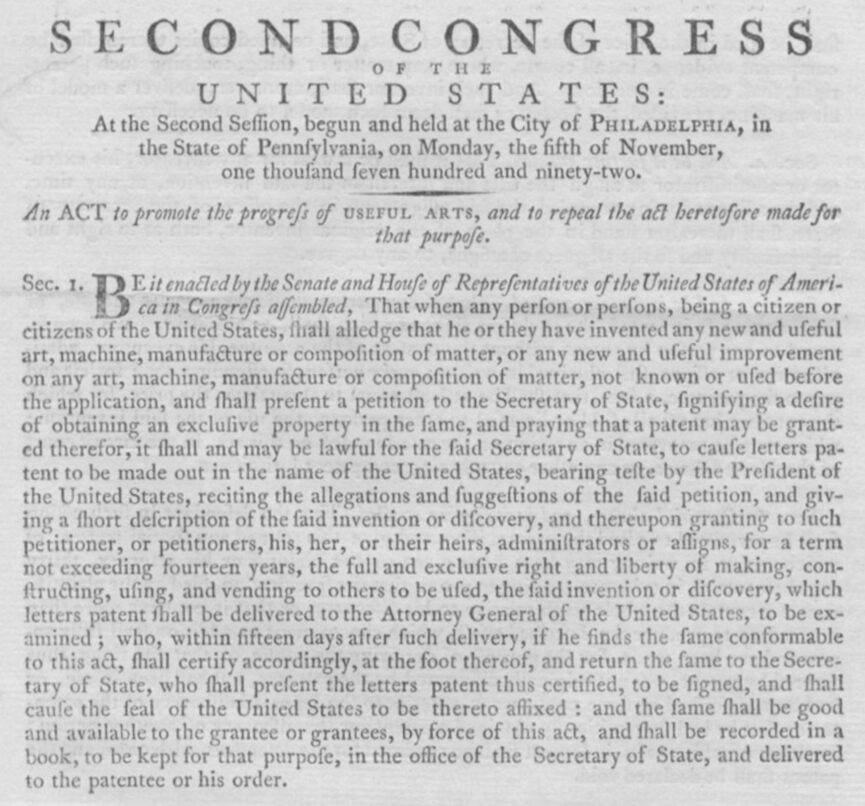
While other sections of the Patent Act deal with novelty and non-obviousness, Section 101 is the gateway. It determines whether your idea even qualifies as patentable subject matter. The text of Section 101 has changed little from the Patent Act of 1793 when Thomas Jefferson was the first Secretary of State.
For many tech startups—particularly in software, biotechnology, and business methods—understanding this rule is critical.
The Four Statutory Categories Under Section 101
Section 101 recognizes four categories of patentable inventions:
- Process
- Machine
- Manufacture
- Composition of Matter
These categories are intentionally flexible. Congress designed them to accommodate new technologies as they emerge, not to limit patents to the tools and industries of the past. Most modern inventions fit comfortably within one or more of these categories when properly described.
1. Processes (Most Relevant for Software and Business Methods)
A process is a series of steps performed to achieve a result. Historically, processes included things like chemical reactions or manufacturing techniques. Today, this category also covers many modern inventions that describe how something is done, rather than what a physical object looks like.
The key feature of a process is action. A patentable process explains what steps are performed and how they interact to produce a concrete result. When an invention focuses on methodical execution rather than a static thing, it often falls into this category.
2. Machines
A machine is a tangible system made up of parts that work together. While the term may sound mechanical, it applies broadly to modern technology, including electronic systems and computer-based architectures.
An invention fits within this category when it describes a functional system—one where components cooperate to perform specific operations. The focus is not on abstract ideas, but on how the system is structured and how it operates as a whole.
3. Manufactures
A manufacture is a man-made article. Traditionally, this category covered physical products such as tools, furniture, or consumer goods. It still plays that role today.
When an invention results in a tangible article that did not previously exist—or improves the structure or function of an existing one—it may qualify as a manufacture. This category often applies to products that can be made, sold, or used as physical items.
4. Compositions of Matter
Compositions of matter include chemical compounds, mixtures, pharmaceuticals, and biological materials. This category applies when an invention involves creating or altering substances at a chemical or molecular level.
Although compositions of matter are most common in life sciences and healthcare, they remain a foundational part of patent law and one of the clearest examples of patentable subject matter when properly claimed.
What Section 101 Excludes
Even if an invention fits into one of the four statutory categories, it may still fall outside patentable subject matter. Over time, courts have identified three types of subject matter that patents cannot claim:
- Laws of nature
- Natural phenomena
- Abstract ideas
These exclusions exist to prevent patents from monopolizing fundamental building blocks of science, nature, and human thought.
Laws of Nature and Natural Phenomena
Laws of nature and natural phenomena are things that exist independently of human effort. Physical principles, chemical reactions, and naturally occurring relationships fall into this category. Simply discovering or describing them does not create a patentable invention.
Patent law draws a critical distinction between discovering something and inventing a practical application of it.
That distinction was clearly explained by the Supreme Court in Diamond v. Diehr (1981). In that case, the invention relied on a known mathematical relationship describing how temperature affects curing time. The equation itself was not new and could not be patented.
However, the claimed invention did not attempt to patent the equation. Instead, it described a specific industrial process that used real-time measurements and automated machinery to control rubber curing. Because the claims focused on how the principle was applied in practice, rather than the principle itself, the invention qualified as patentable subject matter.
The lesson is straightforward: Patent law protects applications, not discoveries.
An invention may rely on natural principles, but it must apply them in a defined, real-world way that produces a concrete result.
The Mayo Case: Why Observing a Natural Phenomenon Isn’t Patentable
In Mayo Collaborative Services v. Prometheus Laboratories (2012), the Supreme Court ruled that a patent on a medical diagnostic process was not eligible under Section 101. The process involved giving a patient a drug for autoimmune diseases, then measuring naturally occurring metabolite levels in their blood to see if the dose needed adjusting—because certain metabolite concentrations naturally correlate with whether the drug works well or causes harmful side effects. The Court found that this correlation is a natural phenomenon (a basic scientific fact that can’t be patented), and the other steps—like administering the drug and running standard blood tests—were just well-understood, routine, conventional actions doctors already used. Simply applying routine steps to observe a natural phenomenon or a law of nature doesn’t make it patentable; the claims didn’t add anything inventive enough to turn the natural law into a real, eligible invention.
Abstract Ideas
Abstract ideas include concepts such as mental processes, organizing human activity, and fundamental relationships that exist apart from any specific implementation. Patent law excludes these ideas because they are tools everyone must remain free to use.
An invention crosses into patentable territory when it moves beyond stating an idea and instead explains what was built or done to put that idea into practice. The focus remains on implementation, not abstraction. Software patent applications often run into problems when examined by the USPTO.
Bilski v. Kappos and Abstract Ideas
In Bilski v. Kappos (2010), the Supreme Court held that a method for hedging risk was not patentable because it was directed to an abstract idea rather than a concrete application. The decision reinforced that patent law does not protect ideas standing alone, even when they are expressed as methods. For modern inventors, Bilski matters because it clarified that software and business-related inventions can fall into the abstract idea category if they merely describe a concept or practice without tying it to a specific technological implementation.
Alice Corp. v. CLS Bank and “Significantly More”
In Alice Corp. v. CLS Bank (2014), the Supreme Court held that implementing an abstract idea as software on a generic computer is not, by itself, patentable. The Court explained that when a claim is directed to an abstract idea, it must include “significantly more” than the idea alone to qualify as patentable subject matter. In practical terms, this means that software inventions must do more than automate an existing concept or business practice. To satisfy Section 101, the claims must describe a specific technological implementation that improves how computers, systems, or processes operate, rather than merely using a computer as a tool to carry out the idea. The focus is not on whether software is involved, but on whether the invention applies technology in a meaningful and inventive way that goes beyond abstraction.
Why Patentable Subject Matter Matters
Section 101 sets the foundation for the entire patent system. If an invention falls outside patentable subject matter, no amount of novelty or creativity can rescue it.
For inventors, understanding these boundaries early helps avoid wasted effort and leads to stronger patent applications. Clear framing at the outset often determines whether an application moves smoothly through examination or encounters repeated eligibility challenges.
Summing Things Up
Patentable subject matter defines what the patent system protects—and what it leaves free for all to use. The Las Vegas startup ecosystem is rapidly expanding, particularly in technology, gaming, fintech, and entertainment software. Protecting your intellectual property under Section 101 ensures that your innovations can’t be easily copied, giving your business a competitive edge.
When an invention focuses on practical implementation, rather than discovery or theory, it stands on far firmer ground. Understanding this distinction is the first step toward meaningful and enforceable patent protection.
If you are considering patent protection, schedule a consultation with The Thornton Firm to discuss how your invention fits within these foundational rules.