Las Vegas runs on innovation. Casinos constantly look for new ways to attract players, refresh their floors, and stand out in an increasingly competitive market. Game designers, mathematicians, and entrepreneurs develop new table games every year, many of which perform well in real-world play. Naturally, those inventors want patent protection.
But federal patent law no longer treats most card-based casino games as patentable inventions. In fact, since 2016, the odds are stacked heavily against patents for new games played with a standard deck of cards. The reason lies in a single Federal Circuit decision—In re Smith—and how modern patent law defines “patentable subject matter.”
I regularly receive inquiries from Las Vegas residents who believe they can patent a new blackjack variant, poker side bet, or wagering structure. This article explains why most of those inventions now fail under Section 101, how the law changed, and what gaming innovators can still protect today.
Why Gaming Inventors Seek Patents in Las Vegas
Las Vegas offers a unique environment for gaming innovation. A successful table game can generate licensing revenue, gain placement on casino floors, and build a recognizable brand. Unlike many other industries, casino games often involve significant upfront investment in math modeling, testing, and regulatory approval. Inventors naturally want to protect that investment.
However, approval from the Nevada Gaming Control Board does not translate into patentability. Nevada focuses on fairness, integrity, and compliance. The United States Patent and Trademark Office focuses on whether an invention fits within the statutory limits of patent law. Those two systems operate independently, and many inventors conflate them.
A game can be approved, profitable, and widely played—and still be unpatentable.
How Patentable Subject Matter Became the Main Obstacle
Section 101 of the Patent Act defines what types of inventions qualify for patent protection. Although the statute uses broad language, courts have long excluded abstract ideas from eligibility. For many years, this doctrine rarely affected casino games.
That changed after the Supreme Court’s decisions in Mayo and Alice. Those cases introduced a two-step analysis that asks whether a claim is directed to an abstract idea and, if so, whether it includes an inventive concept that transforms the idea into something patent-eligible.
Once examiners began applying this framework to gaming inventions, card games became vulnerable. Rules for playing a game, placing wagers, or comparing hands looked increasingly abstract. When those rules relied on centuries-old playing cards, the analysis often ended quickly.
What In re Smith Changed
In re Smith involved a blackjack-style game played with a standard 52-card deck. The inventors argued that their new rules created a distinct and valuable game. The Federal Circuit disagreed.
The court held that rules for conducting a wagering game amount to an abstract idea. More importantly, it held that using a conventional deck of cards does not supply the inventive concept needed to overcome that abstraction. The court described shuffling and dealing cards as “conventional, traditional practices.”
That reasoning now dominates how the USPTO evaluates card-based casino games. When an invention relies on a standard deck and new rules, examiners routinely reject it under Section 101.
The decision effectively closed the door on patents for most traditional table games.
Why New Card Games Struggle After Smith
Modern patent law does not reward creativity in game mechanics alone. It rewards technological improvements. When an invention changes how people make decisions, place bets, or compare hands—but does not change the underlying technology—the law treats it as abstract.
Even games with sophisticated mathematics, attractive house edges, or strong player engagement usually fail if they rely solely on traditional cards and dealer actions. The USPTO views those elements as tools that have existed for centuries.
I have personally prosecuted an application rejected on this basis. The examiner did not question the game’s originality or commercial potential. The rejection rested entirely on the use of a standard deck and the absence of technological innovation. That experience mirrors what many inventors now face.
The Three Card Poker Patent and a Different Legal Era
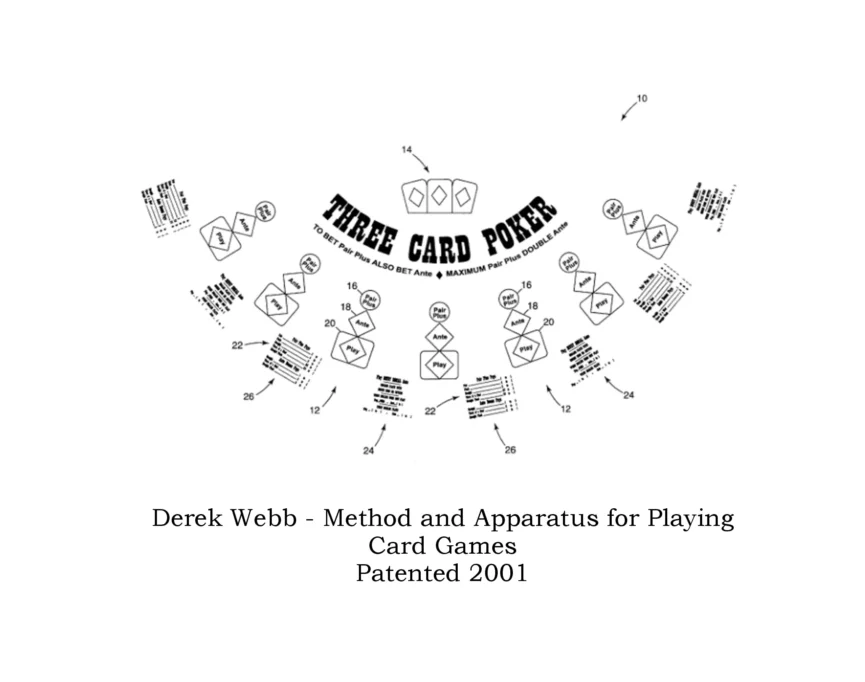
The contrast becomes clear when looking at the history of Three Card Poker. Expired U.S. Patent No. 6,237,916 lists Derek Webb as the inventor and Shuffle Master as the assignee. Webb is a prolific gaming inventor, and Three Card Poker became one of the most commercially successful table games ever deployed in Las Vegas and beyond.
The patent covers the rules and wagering structure of the game. It uses a standard deck, conventional dealing, and familiar betting mechanics. At the time, the USPTO examined the invention under novelty and obviousness. Section 101 posed no meaningful obstacle.
If the same application were filed today, it would almost certainly fail. Under In re Smith, the claims would be characterized as rules for organizing a wagering game using conventional tools. The standard deck would doom the application at the eligibility stage.
Three Card Poker did nothing wrong. The law simply changed.
What Gaming Inventions Are Still Patentable
Despite these limits, gaming patents remain very much alive in Las Vegas. The key difference lies in technology. Inventions that improve how games operate, how casinos manage tables, how cards are detected or tracked, or how wagers are processed continue to qualify for protection.
Electronic table games, card-recognition systems, automated shufflers, RFID-enabled components, security mechanisms, and AI-driven analytics all fall well within modern eligibility standards. Hybrid physical-digital games often succeed where purely rule-based games fail.
The law does not prohibit innovation. It requires that innovation take a technological form.
What Inventors Should Understand Before Filing
Many inventors assume that a new game equals a patentable invention. That assumption no longer holds. Today, the central question is not whether the game is clever or profitable. The question is whether the invention improves technology rather than reorganizing gameplay.
If a game relies on a standard deck and new rules, In re Smith creates a steep uphill battle. If the invention introduces new hardware, software, data processing, or physical structures, the analysis changes dramatically.
Inventors benefit most when they evaluate patent eligibility early, before investing heavily in testing, branding, or regulatory submissions.
Conclusion
Las Vegas will always produce new gaming ideas. That creativity remains one of the city’s defining traits. But patent law has evolved in ways that surprise many inventors. Since In re Smith, patents for traditional card games have become rare exceptions rather than the norm.
Patents still protect gaming innovation, but only when that innovation takes a technological form. Understanding this distinction helps inventors make smarter decisions and avoid costly missteps. Contact The Thornton Firm for more information.