As we celebrate our nation’s 250th anniversary and Presidents’ Day, it is a good time to reflect on our nation’s birth, and the legal institutions the founders worked to establish. The founding generation understood that independence required much more than separation from the British Crown. Independence required durable national systems that could support economic growth, encourage innovation, and operate across state lines. Our patent system was one of those institutions.
From the start, patents were not treated as a minor administrative matter. The founders viewed them as a legitimate, dare I say necessary, exercise of federal power. They grounded that power in our Constitution and implemented it through early national legislation.
The Constitutional Foundation
Our Constitution grants Congress explicit authority to issue patents and copyrights. Article I, Section 8, Clause 8 provides that Congress shall have the power:
“To Promote the Progress of Science and useful Arts, by securing for limited Times to Authors and Inventors the exclusive Right to their respective Writings and Discoveries.”
This language reflects balance and compromise. Our Constitution permits Congress to grant exclusive rights, but only for limited times and only to promote progress. The founders did not view patents as permanent monopolies. They viewed them as incentives designed to serve the public good.
Madison, Jefferson, and the Committee of Detail
The origins of the patent clause trace most directly to James Madison and Thomas Jefferson.
Madison and Jefferson shared a belief that our early republic should encourage innovation, but they approached patents with cautious restraint. On August 18, 1787, Madison submitted proposed congressional powers to the Constitutional Convention. His proposals included authority to secure intellectual property rights for authors and to encourage the advancement of useful knowledge and discoveries. Other delegates submitted similar language. The Convention referred these proposals to the Committee of Detail.
The Committee of Detail converted those ideas into draft constitutional text. That draft included what became Article I, Section 8, Clause 8. The Convention adopted the clause without recorded debate or objection. That silence is telling. The delegates viewed patent authority as appropriate for the federal government and uncontroversial in principle.
Jefferson’s influence shaped the system that followed. He was an inventor and a skeptic of the British system, which granted permanent monopolies. He believed exclusive rights were justified only when they produced real public benefit.
In Federalist No. 43, Madison argued for limited monopolies as a practical tool to reward ingenuity while ultimately benefiting the public. Jefferson, by contrast, continued to harbor deep skepticism toward monopolies. He believed ideas were inherently shareable and later compared them to a candle that loses nothing by lighting another. But as our first Secretary of State and the de facto first patent examiner under the Patent Act of 1790, Jefferson accepted that temporary exclusivity could stimulate useful innovation—so long as patents were granted sparingly and only for truly novel and useful inventions.
Washington and Early Implementation
If Madison and Jefferson provided the philosophical foundation, George Washington was the founder who ultimately brought our patent system into existence.
Washington presided over the Constitutional Convention. His leadership gave credibility to the document that emerged and was ratified as our Constitution. Unanimously elected as our first President, he put the Constitution’s provisions into effect.
Washington signed the Patent Act of 1790, which created the first federal patent system. He later signed the Patent Act of 1793, which simplified and refined that system. The 1793 Act is widely understood to have been principally drafted by Jefferson, who oversaw patent administration.
Section 1 of the Patent Act of 1793 stated, in part:
“When any person or persons, being a citizen or citizens of the United States, shall allege that he or they have invented any new and useful art, machine, manufacture, or composition of matter, or any new and useful improvement on any art, machine, manufacture, or composition of matter…”
That language established the core categories of patent-eligible subject matter. It later evolved into what is now 35 U.S.C. § 101. More than two centuries later, the same framework still governs patent eligibility in the United States.
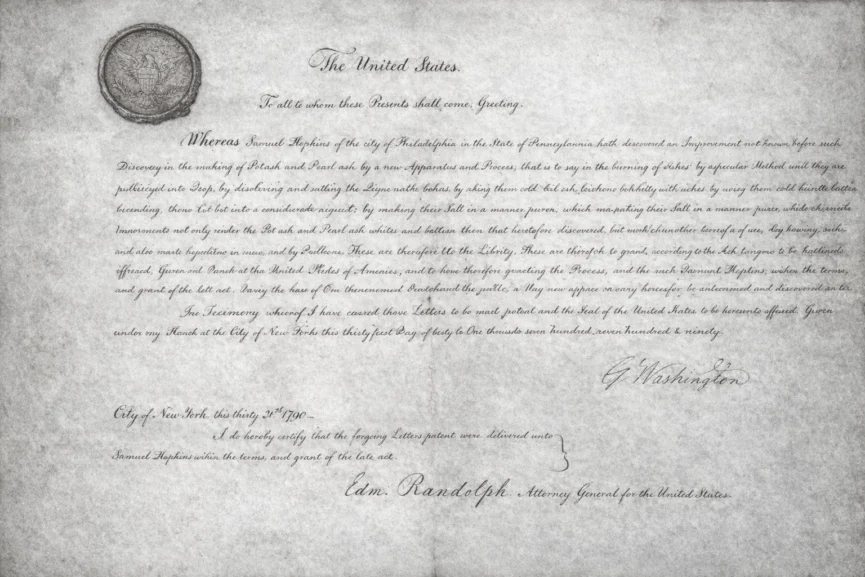
Washington also personally signed the first United States patent, issued on July 31, 1790. The document bears his signature and that of Edmund Randolph, then Attorney General of the United States.
These actions were not merely symbolic. In our nation’s early years, patents received attention at the highest levels of government.
Lincoln and the Inventor’s Perspective
Decades later, Abraham Lincoln engaged with the patent system from another angle.
Lincoln received U.S. Patent No. 6,469 for an invention titled Buoying Vessels Over Shoals. The invention addressed a problem he encountered while working on riverboats. It reflected practical experience, not abstract theory.
Lincoln remains the only U.S. president to hold a patent. His experience shaped his views on innovation. He later described the patent system as adding “the fuel of interest to the fire of genius.” He understood patents as incentives for real-world problem solving.
A Deliberate System
Taken together, these luminaries show how deliberately our patent system was implemented and how it developed over time.
Madison provided constitutional structure. Jefferson shaped statutory language and restraint. Washington implemented the system and gave it legitimacy. Lincoln demonstrated its value from the inventor’s point of view.
Our system did not arise by chance. It grew from constitutional text, early legislation, and direct participation by the nation’s leaders. That foundation continues to drive innovation and shape patent and intellectual law today.