Artificial Intelligence (AI) tools can save an inventor days, weeks, or even months of research. Learning the terminology, understanding existing technology, and identifying the problems others have encountered can give you a substantial head start in developing your invention and preparing a patent application.
In my earlier post, “Can AI Draft a Patent Application?”, I discussed the limitations of AI-assisted drafting. I still would not rely on an artificial intelligence platform to prepare a patent application without review by a registered patent attorney or patent agent. However, AI can help you research the background technology and better understand your field of endeavor before drafting begins.
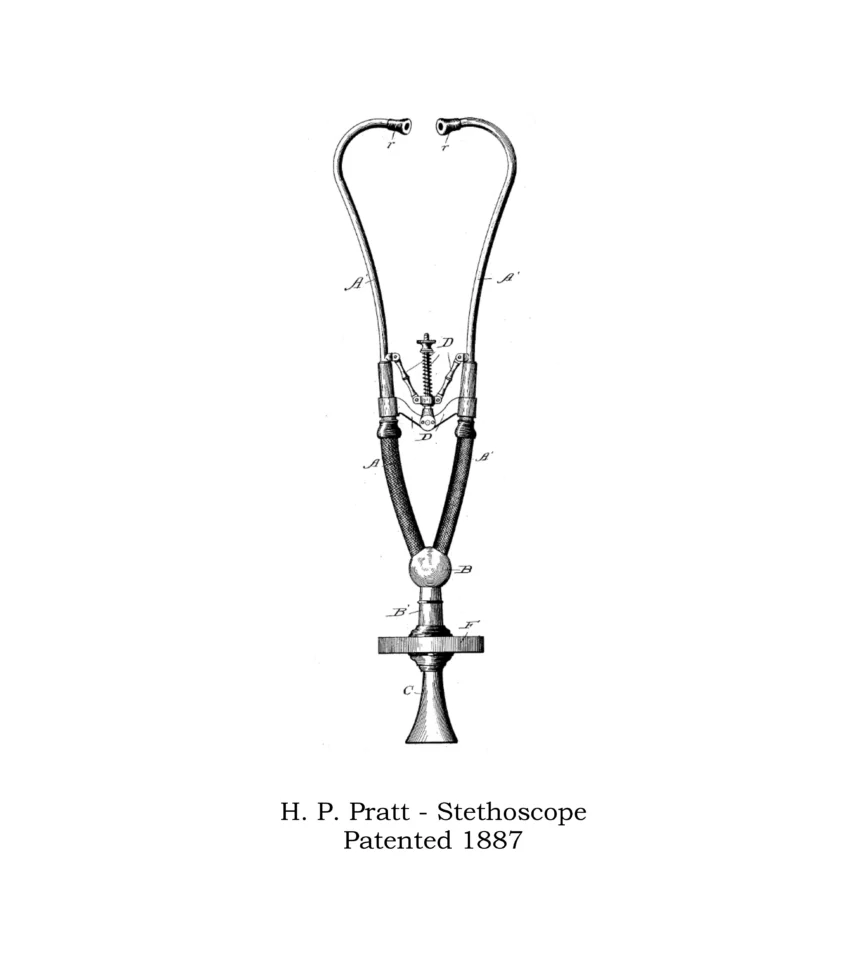
Consider the stethoscope shown in Harry P. Pratt’s 1887 patent. Pratt sought to make faint body sounds easier to hear. Today, an inventor might approach that same problem with a sensor placed on the chest and connected wirelessly to Bluetooth earbuds. Researching that approach requires some understanding of sensors, sound processing, and wireless transmission. AI can help you learn those basics, investigate what already exists, and understand the difficulties involved.
Let’s use that example to explore how an independent inventor can put AI to work researching background technology while keeping confidential invention details private.
Understand the Background Before Prompting
A U.S. nonprovisional utility patent application should include a “Background of the Invention” section. This section typically identifies the technological field, describes relevant existing approaches, and, where appropriate, explains the problems the invention addresses.
Understanding that background helps you ask questions and helps you prompt an AI platform. What do you know about the field? What limitations do you know that exist? How does your design differ?
You do not need to become an expert in every related technology. But a basic understanding can help you make design decisions, find useful references, and explain your invention more clearly. AI platforms can make this process far less painful than traditional research methods.
Keep Your Invention Confidential
Before entering a prompt, ask yourself whether it contains anything you believe may be confidential. If it does, leave that information out.
Research publicly known technology without revealing your invention’s unique features. You can investigate heart-sound sensors without uploading unpublished drawings, proprietary circuitry, source code, or details of a new attachment mechanism.
For example, “Explain established methods for detecting heart sounds at the chest” asks about a technical field without disclosing your particular solution.
Do not assume an AI conversation carries the confidentiality protections of a discussion with your patent attorney. Before sharing confidential material with an AI service, understand its data-handling terms and obtain appropriate guidance. When in doubt, keep your prompts general and reserve your invention’s details for a confidential discussion with your attorney or agent.
Give the AI a Specific Research Task
A broad request usually produces a broad answer. Give a platform like ChatGPT a defined problem and enough public context to focus its response.
For our example, try, “I am researching publicly documented technology for capturing heart sounds at the chest and transmitting that audio to wireless earphones. Explain the main sensing approaches, the components a system would require, and the technical terminology I should learn. Identify sources I can verify.” Prompt it to perform research as a medical device engineer would.
Then ask questions about anything you do not understand: “Explain how a contact microphone differs from an acoustic microphone,” or “How does the sensor convert chest vibrations into an electrical signal?”
Keep asking until you can explain the basic operating principles in your own words. A long answer full of unfamiliar terminology does little good unless you understand it.
Learn the Vocabulary That Improves Your Search
Inventors often miss relevant documents because they do not know the terms engineers and patent writers use.
Ask, “What terms describe the detection, recording, and transmission of heart sounds in patents and engineering literature? Explain each term and suggest search phrases.”
Use those suggestions to search patent databases, technical publications, and manufacturer websites. Ask the AI to refine phrases that produce questionable or irrelevant results.
Also question terms that appear related but describe different technologies. For example, “Explain the difference between recording heart sounds and recording an EKG. What does each system detect?”
An EKG records the heart’s electrical activity. It does not record heart sounds. That distinction matters when choosing sensors and searching references. A broad search for “heart monitoring” may lead you into several different technical fields.
Use an Old Patent to Ask Better Questions
Pratt’s stethoscope patent may be old, but it still gives us a concrete document to examine.
Ask, “Using only U.S. Patent No. 370,711, explain the problem Pratt sought to address, the components he added, and how he said they worked. Identify the passages and figures supporting your explanation.”
Follow with, “Which features does Pratt describe as existing technology?” Then ask “Which features does he identify as his improvement?”
These questions help you separate the background from the inventor’s contribution. They also encourage you to examine the document instead of accepting a summary at face value.
Ask another question: “Does the patent provide experimental evidence for its stated benefits?” Another good question to ask is “Does it describe the inventor’s intended operation?”
These distinctions matter. An old patent’s description of a proposed benefit can be useful in learning how technology has evolved.
Think Big Picture
Once you understand the basic sensing approaches, investigate how the complete system would work.
Ask, “Explain the signal path for transmitting heart sounds from a chest sensor to Bluetooth earbuds. Address sensing, amplification, filtering, digitization, wireless transmission, and playback. Identify the questions an engineer should investigate at each stage.”
Then focus on potential difficulties: “How could movement, sensor contact, and background noise affect the recording? Could filtering, audio compression, or earbud frequency response alter sounds the listener needs to hear? Distinguish documented findings from your own inferences and provide supporting sources.”
You now have specific research questions about the whole system. Those questions can guide further reading and identify issues that require testing.
Keep an open mind. The research may reveal an established solution, a simpler approach, or a difficulty you had not considered.
Verify the References
I cannot emphasize this enough: You must verify work performed by an AI platform.
Ask a platform with web search capabilities to find actual documents: “Find published patents, technical papers, and manufacturer documents addressing electronic stethoscopes, chest-mounted heart-sound sensors, and wireless audio transmission. Provide titles, dates, publication numbers where applicable, and links. Explain which part of the system each reference addresses. If you cannot verify a reference, say so.”
Open the references yourself. Confirm that each document exists and supports the explanation. AI can generate incorrect statements and fabricated citations, even when you expressly ask for accuracy. NIST’s generative AI guidance describes these risks.
When you find a useful reference, narrow the task: “Using only this document, explain the sensing method and the limitations it expressly discusses. Identify supporting pages, paragraphs, or figures.”
If the answer goes beyond the source, ask, “Does the document state that, or did you infer it?” Keep unsupported assumptions out of your research notes.
Bring Useful Research to Your Patent Attorney
As you verify sources, organize what you learn.
Ask, “Using only the references we have reviewed, prepare a background-technology brief. Explain the terminology, summarize existing approaches and documented limitations, and identify unresolved questions. Cite the source for each technical statement. Do not conclude that my invention is novel or patentable.”
Review the brief and bring it, the original references, and your invention notes to your patent attorney or agent.
Do some research before that conversation. Even a modest understanding of your field of endeavor can go a long way. You can explain your design more clearly, and your attorney or agent can ask more focused questions.
Treat the brief as research material. Your attorney or agent should decide what belongs in the application’s Background section. Statements describing technology as “known,” “conventional,” or “prior art” can have legal consequences, including admissions of prior art.
Prepare for a Faster Provisional Filing
This groundwork can help a patent attorney or agent prepare a provisional application more quickly and get an initial filing on record with the USPTO. AI can help organize your notes and develop preliminary text for professional review.
You do not need to complete an exhaustive study before discussing a filing. Aim to understand enough of the field to explain your invention clearly. Your attorney or agent can then focus on preparing a disclosure that adequately describes the invention and supports the early filing date you seek.
Resist the Temptation to Have AI Write the Application
After using AI to research the technology, you may feel tempted to ask it to write your entire patent application. It can produce something that looks convincing, complete with a background, detailed description, abstract, and even claims.
But appearance does not establish legal adequacy. Without the legal training to evaluate the disclosure and claims, you may not recognize what the draft leaves out, unnecessarily limits, or fails to support. Filing that draft without professional review makes a very risky bet on the protection your invention may receive.
Researching a chest sensor and Bluetooth earbuds also does not establish that a particular combination is new or patentable. An AI overview may overlook a reference or misunderstand what an earlier document discloses.
Use AI to understand the field, investigate sources, and explain your invention clearly. That work may save days, weeks, or months of preparation and reduce the time needed to draft a proper application. Then work with a registered patent attorney or patent agent to turn that groundwork into a carefully prepared filing.
If you are developing an invention, contact The Thornton Firm to discuss your technology and the next steps toward patent protection.